McKinsey: 32% of Companies Now Build Software Instead of Buying It. The B2B GTM Response.
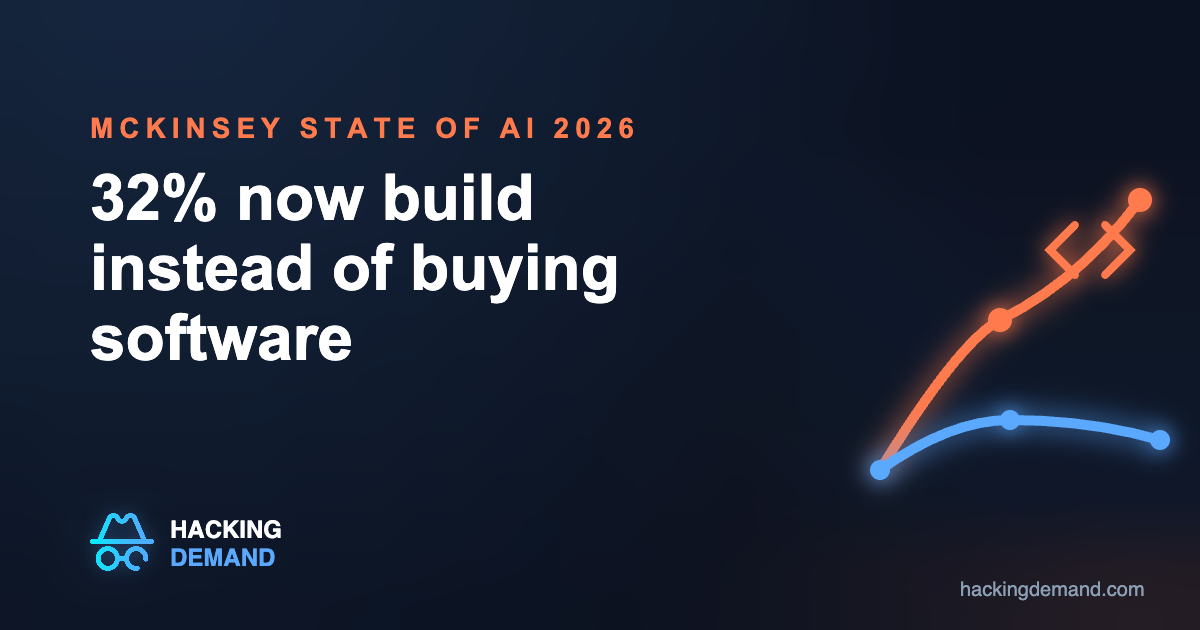
Thirty-two percent of organizations decided against buying at least one software product or feature because they could build it in-house with AI coding agents. That is the finding B2B software vendors should be sitting with from McKinsey's new State of AI 2026 survey, fielded May 4 to June 8 across 1,719 respondents in 97 countries. Among McKinsey's AI "high performers," it is nearly half. Your buyer's newest alternative vendor is their own coding agent, and it just made the shortlist.
What did McKinsey's State of AI 2026 survey actually find?
The full report covers adoption, cost, and workforce expectations, but the build-vs-buy numbers are the ones that change go-to-market math:
| Finding | Number |
|---|---|
| Skipped at least one software purchase because they could build it with agentic coding tools | 32% |
| Same behavior among AI high performers (5%+ of EBIT attributed to AI) | Nearly half, vs 31% of everyone else |
| Large enterprises ($1B+) scaling AI agents, up from 27% last year | 40% |
| Organizations scaling software coding agents (31% at large enterprises) | About 2 in 10 |
| Respondents whose AI use is constrained by operating costs, including tokens | 1 in 5 |
The behavior is concentrated exactly where you do not want it: McKinsey says forgone purchases are most common in technology and healthcare, followed by professional services and energy and materials. Tech companies, the buyers most B2B SaaS vendors sell to, are the most likely to build instead. And this is not a one-survey blip. Retool's 2026 build-vs-buy report found 35% of enterprises had already replaced at least one SaaS product with custom software.
Which software gets built instead of bought?
The pattern in the data is that thin workflow tools are the exposed layer. If your product is a form on top of a database, a dashboard on someone else's data, or a single workflow a competent operations person can describe in a paragraph, an agentic coding tool can now produce a good-enough internal version in days. McKinsey's respondents skipped "products or features," and the features part matters: buyers are also building the add-on module instead of upgrading their plan tier.
What survives is what a coding agent cannot generate. Proprietary data is the clearest case: a team can vibe-code a prospecting workflow, but it cannot vibe-code Apollo's contact database, ZoomInfo's company graph, or Cognism's verified phone data. Networks, integrations that require partnership agreements, compliance certifications, and anything with real distribution behind it hold their value. The software in the middle, priced like a moat but built like a weekend project, is where the 32% came from.
Get the next analysis first. We break down reports like this for B2B GTM teams every week. Grab the free demand gen resource library and get the follow-ups before your competitors read them. Get the free resources |
How should B2B software vendors respond?
Sell the run cost, not the build cost. The strongest counterargument is already inside McKinsey's own data: one in five organizations reports AI operating costs, including tokens, are constraining their AI use, and high performers report cost constraints on coding agents about three times as often as everyone else. The demo an internal champion built in a week still needs hosting, security review, maintenance, and an owner who does not quit. Put a total-cost-of-ownership calculator in your sales motion and make the prospect price year two, not week one.
Sell to the builders, not around them. The internal team evaluating "can we build this" is now part of your buying committee. Give them honest technical documentation, an API, and a self-serve tier, because a stonewalled builder becomes your in-house competitor.
Re-anchor on what cannot be built. Lead your positioning with the data, network, or compliance asset, not the workflow UI. If your differentiation slide is all interface, the McKinsey number is your problem.
What does this mean for demand gen?
A new query class just became commercially decisive: "build vs buy [your category]." Buyers are asking it, and they are asking AI assistants, not just Google. If the answer engines summarize your category as easy to self-build, you lose deals you never saw. That makes owning the build-vs-buy comparison for your category, with honest math, one of the highest-leverage content plays of 2026. It is the same first-to-answer logic we covered in yesterday's look at ValueSelling's outbound research: the vendor who publishes the credible answer first gets cited. Our SEO and AEO page sprint exists for exactly this kind of query.
Is your category exposed to build-vs-buy? Talk it through with us. We will tell you plainly whether your GTM needs a build-vs-buy counter and what it should say. Talk to an expert |
Frequently asked questions
What did McKinsey's State of AI 2026 survey find about build vs buy?
32% of respondents said their organizations decided against buying at least one software product or feature because it could be built internally with agentic coding tools. The survey ran May 4 to June 8, 2026 with 1,719 respondents in 97 countries.
Which companies are most likely to build software instead of buying it?
Technology and healthcare organizations report it most, followed by professional services and energy and materials. McKinsey's AI high performers are the heaviest builders: nearly half have skipped a purchase, versus 31% of other respondents.
Which software categories are most at risk?
Thin workflow tools: internal dashboards, form-and-database apps, single-workflow point solutions, and paid add-on features. Products anchored on proprietary data, networks, integrations, or compliance are far harder to replace with an internal build.
When is buying still better than building with AI coding agents?
When the real cost shows up after launch. Internally built tools still need hosting, security, maintenance, and an owner, and McKinsey found one in five organizations is already constrained by AI operating costs. For anything mission-critical or data-dependent, buying usually wins on total cost of ownership.
Sources, checked September 2, 2026: McKinsey, The State of AI in 2026 (published August 25, 2026); Retool 2026 Build vs. Buy Report announcement.
Founder of Hacking Demand. 12+ years building B2B demand generation, including 330+ B2B and B2C webinars produced.
Keep building demand
Want us to build your demand engine?
Done-for-you webinars, AI agents, and pipeline plays, live in days.
Talk to an expertBrowse the hacks