The highest-trust channel left
Cold outbound is saturated and paid clicks keep getting more expensive. A buyer who gives you 45 minutes of attention is the warmest lead you can create at scale.
 HACKING
The Webinar Engine. Demand that repeats every month.
A webinar program is the most repeatable demand channel a B2B team can run: the same five-week cycle, every month, and every episode adds to the last. We plan the season, build the system and run it with you. AI agents do the production work. Senior operators own strategy, panelists, ads and the live room.
The system behind
350+ webinars.
Webinars work as the program you rally everything else around: they drive new demand, re-engage open deals and customers, and give sales a reason to call at the exact moment interest peaks.
Cold outbound is saturated and paid clicks keep getting more expensive. A buyer who gives you 45 minutes of attention is the warmest lead you can create at scale.
Every episode runs the same five-week cycle and about 40 tasks. Work that repeats can be systematized, and most of it can be done by AI agents.
The hub grows every month, replays keep collecting registrations, and the audience you build carries into the next episode.
Webinars fill the top of the funnel, re-engage open deals and customers, and give sales a reason to reach out when interest is highest.
Four parts, each built to be reused. The season and the foundation are done up front, so every episode only runs the cycle.
We map a topic calendar to your ICP and funnel gaps, design the series brand and hub, and book panelists and moderators months ahead. Every episode starts with the hard part done.
Pages, hub, emails, follow-up and tracking, built in your stack or stood up for you. Yours to keep.
Each episode runs the same cycle of about 40 tasks. Agents do the production work; operators make the calls.
Same-day replay, clips, a written recap and segmented follow-up. One webinar becomes weeks of content and months of on-demand registrations.
Each episode is a five-week promotion cycle plus the week after. Agents take the repeatable work. Operators take every call that needs judgment.
Topic locked, panel confirmed, goals set
Pages, emails and workflows live. Promotion begins
Email waves, social and paid channels layered in
Last call, session branding, dry run
Moderated show, demo capture, same-day replay
Clips, recap, segmented follow-up, pipeline review
Most webinars fail on promotion, not content. We run the formats that fit your goal and the channels that fill them, then keep what works.
The backbone: a recurring show with outside experts, a branded hub and a growing on-demand library.
Four connected sessions people commit to as a course. One of the highest performers we have ever run.
Launches, founder talks, product deep dives and seasonal topics, run on the same system.
Interest peaks when someone registers. Every step after that has a job: move them toward a conversation with sales.
The thank-you page carries the next step: book a demo, take an assessment or grab a resource. Most teams waste this moment on a plain confirmation.
A prospecting agent, a sales sequence or a nurture starts the same day, tailored to who registered and why.
Reminders that sell the session, speaker posts and a reason to show up live, not just watch the replay.
Polls, offers and booking links placed where attention is highest, with questions captured for sales.
Attended, missed, asked a question, clicked the offer: each group gets its own next step, and sales sees it in the CRM.
Stream live from your own website, where you want your customers anyway. YouTube Live is free, attendees get in with one click, and the page switches states on its own schedule.
A real build: SafetyWing
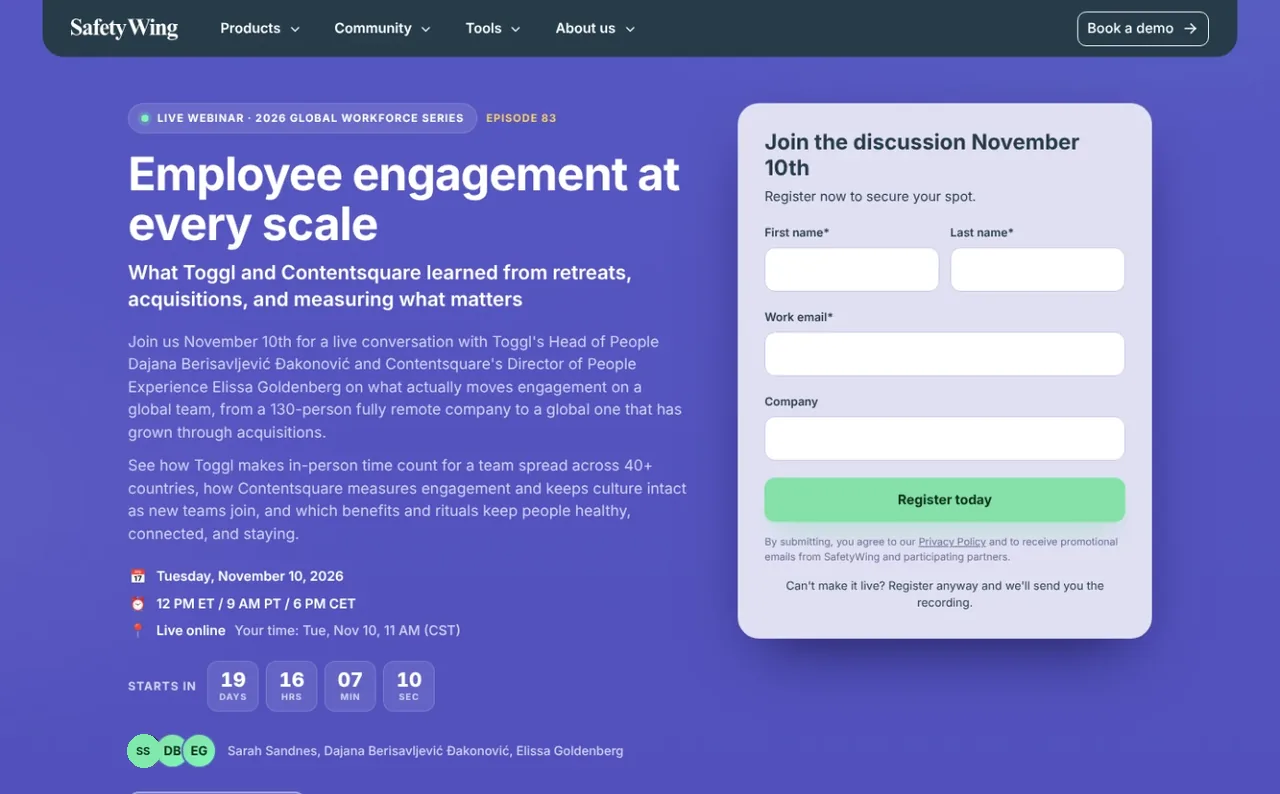
A registration page on their own site: topic, speakers, a countdown and the form. Every sign-up goes straight to their CRM.
Same URL the whole time. Built and run by us for SafetyWing.
Every episode is cut, written up and sent back out, so one hour of recording keeps working long after the live session ends.
When we started, the webinar program was SafetyWing’s only demand gen system, so it had to run the whole funnel: awareness, lead capture, nurture and the handoff to sales. It worked, and it still runs every month.
A registration multiplier. B2B episodes are pre-approved for SHRM professional development credits, so HR leaders earn certification hours for attending.
Past panels have included people from Google, HubSpot, GitLab, Deel and Loom. Episode lists update daily from both hubs.
An enterprise B2B SaaS company already had a webinar program with good content, but no way to promote it: 191 registrations and 2 qualified conversations per webinar. We rebuilt the promotion and follow-up. Here is what changed, month by month.
Four ways to run the same system, from your team running it in-house to our team running every episode. On HubSpot or a custom build.
One full five-week cycle and one live webinar, everything included: topic, landing page, emails, promotion, moderation and follow-up. Prove the channel before you commit to a program.
Scope a pilot ↗We build the system with your team and coach them through their first two cycles: the checklist, templates, email ladders and registration follow-up. Your team runs it after that.
Ask about training ↗A real webinar program needs four roles and a tool stack. Here is what that costs to hire, against how our system covers the same work.
In-house figures are typical US salary and tool costs for each role. Our figure is the starting point for a monthly program. Each engagement is scoped to the model you pick before work starts.
The B2B Webinar Playbook is the production system behind 350+ webinars, as a free PDF: the five-week promotion calendar, email sequences, run of show, channel benchmarks and follow-up from registration.
ALTERNATIVES WE ALSO USE Riverside (studio recording) · Demio (hosted webinar platform) · Descript (editing) · Castmagic (repurposing) · Fireflies (transcripts) · Synthesia.io (ai video promos)
We pick tools for fit, not commission. Some partner links may earn Hacking Demand a commission at no extra cost to you.
A B2B webinar system is a monthly webinar series run as a repeatable process: a planned season of topics, registration pages and a hub that grow every month, email and follow-up sequences that start the moment someone registers, live production, and repurposing. It turns webinars from one-off events into a pipeline channel.
Most teams run webinars as one-off events with a single invite email. A system adds an episode format, partner distribution, paid amplification, an on-demand library and a sales follow-up loop. One enterprise client went from 191 registrations and 2 qualified conversations per webinar to 892 registrations and 15 qualified conversations within three months.
From a real program (SafetyWing): the B2B series averages about 1,300 registrations a month and has reached close to 1,700, and the B2C series averages about 600 per webinar. Mature episodes bring 10 to 15 opportunities each, and pipeline passed $100k a month by month 6. Early months validate topics and build the audience. The system compounds from there.
Both, on purpose. AI agents handle landing page and email copy, registration workflows, reminder ladders, social drafts, recording processing and CRM sync. Senior operators own strategy, panelist relationships, LinkedIn Ads and live moderation. Your team approves, hosts if you want to, and takes the sales conversations.
A full promotion cycle takes five weeks from locked topic to live day, and that is what we recommend for a first episode. With a topic, speaker and audience already in place, a single webinar can be built and live in days.
No. Start on email, partners, outreach and organic distribution, then layer in $2k to $5k a month of ad spend once topics and ICP are validated. Meta works well for B2C and B2B, LinkedIn is the most precise for B2B roles, and Taboola adds cheap volume and retargeting. One enterprise client added LinkedIn Ads at $52 per registration in month 2 and Taboola at $13 per registration in month 3. Its first jump, from 191 to 494 registrations, came before any ad spend.
Yes, when you run HubSpot. Campaigns, pages, forms, workflows, lifecycle stages and reporting are built natively in your portal, so registrations and attendance flow straight to your CRM and sales team. Not on HubSpot? We build on whatever CRM and website you run. The headless setup works on any website and with any CRM, HubSpot or not.
Whatever fits: StreamYard, YouTube Live, Zoom, Zuddl or another platform you already pay for, or a headless setup where the stream runs on your own website. Recording, editing and repurposing tools are added as the program needs them. Promotion runs on email, Meta, LinkedIn and Taboola ads, outreach, social and partner channels. With no marketing stack yet, we stand one up for you, with partner pricing on the tools through our tool marketplace.
A headless webinar has no webinar platform. It runs the whole event on your own website instead of a vendor's page. YouTube Live or StreamYard is embedded on the page, with your Q&A, comments, polls and offers around it, and the page switches from registration to countdown to live to replay on its own. It removes the platform license, keeps visitors on your site, and builds your YouTube channel at the same time. See the headless build.
Yes. We have a deep network of panelists and moderators, and recruiting and coordinating them is part of the program. Credible outside voices are one of the biggest drivers of registration. SafetyWing panels have included people from Google, HubSpot, GitLab, Deel and Loom, and we can supply a moderator when you need one.
A working system. Even the Webinar model, where your team runs every cycle, is built and set up in your stack: pages, hub, email ladders, follow-up and tracking. The other options add an agent that does the production work, or our team running the program.
It keeps working. The video is cut into clips for social and YouTube, the transcript becomes a blog post and a newsletter recap, and the replay stays on your site collecting registrations. One webinar becomes weeks of content.
By acting at registration, when interest is highest. The thank-you page carries the next step, a prospecting agent or sequence starts the same day, the live session has offers and booking links in the room, and follow-up is split by who attended, missed or asked a question. Most teams only follow up after the show, when interest has already cooled.
About 45 minutes of content plus 10 to 15 minutes of live Q&A. Attention drops past the hour, and a tight session is easier to cut into clips.
For B2B, 35 to 50 percent of registrants attending live is typical. The replay often produces as many qualified leads over time as the live event, which is why follow-up starts at registration, not after the show.
Yes. SafetyWing has two public hubs we built and run: the Remote Health B2B series at webinar.safetywing.com/webinar-hub and the Nomad Insurance B2C series at webinar.safetywing.com/webinar-hub-ni. Together with one-off events and a four-part bootcamp series, that is 100+ webinars.
Every engagement is scoped to how much you want built and how much you want handled, before work starts. You can begin with a single-webinar pilot or team training, and programs run month to month.
Bring your ICP and a topic idea. A senior operator maps the season, the option that fits and what a pilot would look like.